
Orlab

Orlab Logo

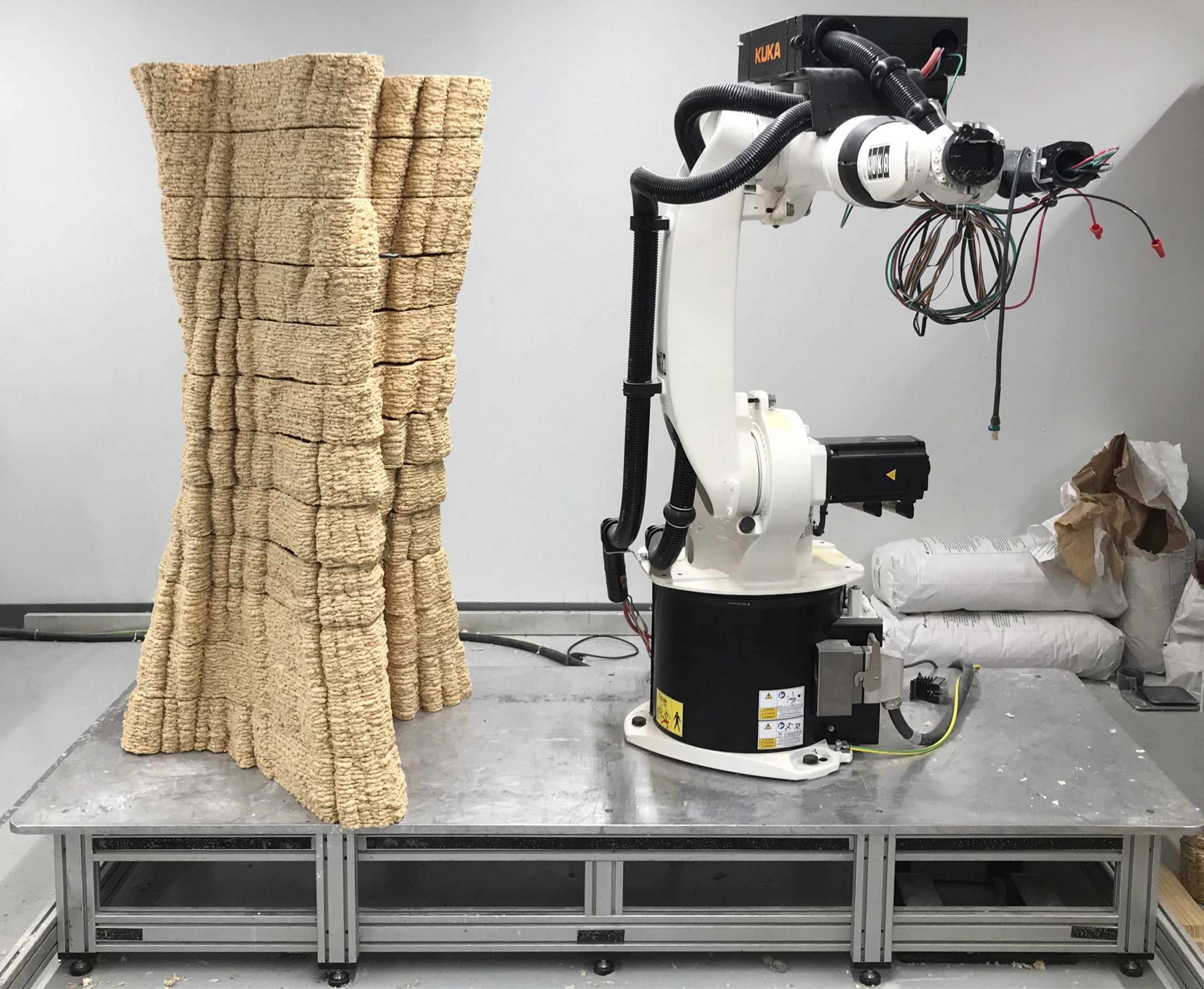
Robot lab
Robot lab

Re-Inventing Architecture

Orlab is the academic arm of Orproject, situated at the University of Cincinnati under the direction of Dr. Christoph Klemmt. We carry out research into new materials and cheap viagra oral jelly 100mg innovative software tools. Recent projects include the development of large-scale 3D-printing of wood, and the Structural Growth method for the topology optimization of trusses.

Projects

php
php
php
php
php
php
%

People

Current researchers

Kailey Akins, Marcel Barts, Meghan Glass, Yuka Imada, Lizzie Sturgeon, Josep Campoy Valdez, Sam Yeganeh

Current and past collaborators

Gregory Beaucage
Igor Pantic
Andrei Gheorghe
Mania Meibodi
Wes McGee

Selected Publications

Journal Papers

Klemmt, Christoph. 2019. Discretization of cellular growth simulations for construction. Architectural Science Review. Taylor and Francis. DOI: 10.1080/00038628.2019.1653258

Klemmt, Christoph. 2019. Cellular Design. In Symeonidou, I (ed.). Archidoct Vol. 6 (2). pp.36-53.

Klemmt, Christoph and Bollinger, Klaus. 2017. Angiogenesis as a Model for the Generation of Load-Bearing Networks. in International Journal of Architectural Computing. Sage Publishing

Klemmt, Christoph. 2013. Semiotics Between Time and Space. The International Journal of Arts Theory and History, Volume 7, Issue 2: pp.69-83. Champaign, IL: Common Ground Publishing

Conference Papers

Klemmt, Christoph. 2023. Growth-Based Methodology for the Topology Optimisation of Trusses. in Gengnagel, C., Baverel, O., Betti, G., Popescu, M., Ramsgaard Thomsen, M. & Wurm, J. (eds.) Towards Radical Regeneration – Design Modelling Symposium Berlin 2022. Springer. pp. 467–475. DOI: 10.1007/978-3-031-13249-0_37.

Klemmt, Christoph, Aghaei Meibodi, Mania, Beaucage, Gregory & Mcgee, Wes. 2022. Large-scale Robotic 3D Printing of Plant Fibre and cheap viagra oral jelly 100mg Bioplastic Composites. in Proceedings of the 40th eCAADe Conference.

Klemmt, Christoph and Pantic, Igor. 2021. Discrete Cellular Growth. in Kory Bieg (ed.). 2018 TxA Emerging Design + Technology Conference Proceedings. pp.72-81.

Klemmt, Christoph, Pantic, Igor, Gheorghe, Andrei, and Sebestyen, Adam. 2019. Discrete vs. Discretized Growth – Discretized Fabrication of Geometries Generated With Cellular Growth Simulations. In Proceedings of the 39th Annual Conference of the Association for Computer Aided Design in Architecture (ACADIA).

Klemmt, Christoph, Gheorghe, Andrei, Pantic, Igor, Hornung, Philipp and Sodhi, Rajat. 2018. Engineering Design Tropisms – Utilization of a bamboo-resin joint for voxelized network geometries. In Proceedings of the 38th Annual Conference of the Association for Computer Aided Design in Architecture (ACADIA). pp.322-327.

Klemmt, Christoph. 2018. Subdivisional Growth Logics. In Kepczynska-Walczak, A, Bialkowski, S (eds.). Computing for a better tomorrow – Proceedings of the 36th eCAADe Conference – Volume 2. pp. 79-84.

Hymes, Connor & Klemmt, Christoph. 2018. Discrete Swarm Logics. In 23nd International Conference on Computer-Aided Architectural Design Research in Asia, CAADRIA 2018. The Association for Computer-Aided Architectural Design Research in Asia (CAADRIA), Hong Kong.

Klemmt, Christoph, & Sugihara, Satoru. 2018. Growth Structures. in Kory Bieg (ed.). 2016 TxA Emerging Design + Technology Conference Proceedings. pp.108-123.

Klemmt, Christoph. 2017. Curved Space as a Design Tool to Control the Growth of Venation and Shortest Path Algorithms. In Alberto T. Estévez (ed.). Proceedings of the 3rd International Conference on Biodigital Architecture & Genetics. ESARQ, Barcelona. pp.162-173.

Klemmt, Christoph & Sodhi, Rajat. 2017. Double-Curved Form Approximation with Identical Discrete Panel Geometries. In 22nd International Conference on Computer-Aided Architectural Design Research in Asia: Protocols, Flows and Glitches, CAADRIA 2017. The Association for Computer-Aided Architectural Design Research in Asia (CAADRIA), Hong Kong. pp.457-466.

Klemmt, Christoph & Bollinger, Klaus. 2016. Load Responsive Angiogenesis Networks. in Kathy Velikov K., Ahlquist S., del Campo M. and Thün G. (eds.). ACADIA 2016 Proceedings of the 36th Annual Conference of the Association for Computer Aided Design in Architecture. pp.88-97.

Klemmt, Christoph & Bollinger, Klaus. 2015. Cell-Based Venation Systems.in Martens, B, Wurzer, G, Grasl T, Lorenz, WE and Schaffranek, R (eds.). Real Time – Proceedings of the 33rd eCAADe Conference. Volume 2. pp.573-580.

Klemmt, Christoph, & Sodhi, Rajat. 2015. Echo. In Evolutionary and Biologically Inspired Music, Sound, Art and Design. pp. 125-135.Springer International Publishing. Chicago

Klemmt, Christoph & Sodhi, Rajat. 2014. Materialising Energy. in: Voyatzaki, Maria. Proceedings of Materiality and Materialism at the Age of Computation. pp.261-272. European Network of Heads of Schools of Architecture.

Klemmt, Christoph. 2014. Compression Based Growth Modelling. in Gerber D, Huang A, Sanches J (ed). ACADIA 2014 Design Agency, Proceedings of the 34th Annual Conference of the Association for Computer Aided Design in Architecture. pp.565-572. Riverside Architectural Press

Poster and zithromax para la venta Project Presentations

Klemmt, Christoph, Pantic, Igor & Gheorghe, Andrei. 2019. Styx. In Projects of the 39th Annual Conference of the Association for Computer Aided Design in Architecture (ACADIA).

Klemmt, Christoph & Pantic, Igor. 2019. Bryx. In Projects of the 39th Annual Conference of the Association for Computer Aided Design in Architecture (ACADIA).

Klemmt, Christoph & Sodhi, Rajat. 2019. Plaisiophy. In Projects of the 39th Annual Conference of the Association for Computer Aided Design in Architecture (ACADIA).

Klemmt, C. and Sugihara, S.. 2018. Architectural Design by Cellular Growth Algorithm. In Artificial Life Conference Proceedings. pp.548-549. MIT Press.

Klemmt, Christoph & Sodhi, Rajat. 2018. Photoptosis. In Projects of the 38th Annual Conference of the Association for Computer Aided Design in Architecture (ACADIA). pp.210-215.

Categories
Academic Installations

Inosculae

Inosculae by Orproject, an art installation made from 3D printed wood, exhibited at the Venice Biennale 2025. Photography by Francesco Russo.
Inosculae by Orproject, an art installation made from 3D printed wood, exhibited at the Venice Biennale 2025.
Inosculae by Orproject, an art installation made from 3D printed wood, exhibited at the Venice Biennale 2025. Photography by Francesco Russo.
Inosculae by Orproject, an art installation made from 3D printed wood, exhibited at the Venice Biennale 2025.
Inosculae by Orproject, an art installation made from 3D printed wood, exhibited at the Venice Biennale 2025. Photography by Francesco Russo.
Inosculae by Orproject
previous arrow
next arrow
Exit full screenEnter Full screen

Inosculae

3D-Printing Wood

Inosculae is an installation exhibited at the 19th International Architecture Exhibition of La Biennale di Venezia titled ‘Intelligens. Natural. Artificial. Collective.’ curated by Carlo Ratti and open to the public from 10 May to 23 November 2025.

The installation Inosculae has been designed by Orproject and the University of Cincinnati for the Biennale Architettura 2025, curated by Carlo Ratti. The project showcases a novel method for the large-scale 3D-printing of wood, developed by Orlab, the research lab at the University of Cincinnati led by Orproject partner Christoph Klemmt. By fusing natural and technological intelligence, we innovatively transform waste materials into architecturally striking structural forms. The piece can naturally decay to form the soil for a new tree, thereby closing the loop between resource, architectural use, waste and regeneration.

Inspired by nature, Inosculae’s design is based on an algorithmic simulation of cellular growth processes. Through cell-division and responses to the cell’s local environment, geometries and textures are grown computationally. For this structure, we have grown two individual trees that converge at the top similar to the natural process of inosculation.

The 3D-printing technique employs an industrial robot to create complex structures from an inexpensive, fully biodegradable and levitra zonder recept in spanje naturally sourced plant material. This lightweight wood foam exhibits remarkable strength in both compression and tension. Through its innovative combination of technology and nature, the project showcases a sustainable alternative for the future of our built environment.

Project Credits

Title: Inosculae
Medium: 3D-Printed Wood
Organization: Orproject & University of Cincinnati
Year: 2025
Principal Investigator: Christoph Klemmt
Project Partners: Rajat Sodhi, Francesco Brenta
Team: Thimesha Amarasena, Giulia Maria Brenta, Matt Briede, Reis Colaço, Anthony Cordek, Nikunj Deshpande, Oluwafemi Faminigba, Alessia Galdi, Dylan Holsapple, Yuka Imada, Bhaskar Jyoti Kalita, Sreya Killamshetty, Japneet Kour, Mea Mccormack, Dan O’neill, Dharma Patel, Gaurang Pawar, Roman Picot, Hilda Rivera, Will Roberts, Kimia Sabouri, Jasmine Said, Bianca Serban, Lizzy Sturgeon, Shruthi Sundararajan, Josep Campoy Valdez
Support: Tim Jachna, Ed Mitchell, Christine Klemmt
Metalwork: Metal Sistem Srl
Exhibition: 19th International Architecture Exhibition of La Biennale di Venezia
Curator: Carlo Ratti
Dates: 10-5-2025 – 23-11-2025
Location: Arsenale, Venezia, Italy
Photography: Francesco Russo, Orproject
Video Music: Ludovico Einaudi – Walk by dhe Perissann

Inosculae by Orproject - 3D printed wood
Categories
Academic

Stamm

Project Stamm, a column 3D-printed from wood.
Stamm
Stamm
Stamm
Stamm
Stamm
Stamm
Stamm
Stamm
previous arrow
next arrow
Exit full screenEnter Full screen

Stamm

3D-Printing Wood

Orlab, the academic branch of architects Orproject, has developed a method for the large-scale 3D-printing of 100% wood and wood products. The fully biodegradable material has been used by the research team to construct Stamm, an architectural column of 2m height.

The sustainable material consists of 60 – 80% untreated wood fibers. Those are connected by binders that are made of cellulose, which likewise is a wood product. This material is therefore fully renewable, biodegradable, and consumes little energy in its production. The resulting lightweight products can be described as wood foams with significant strength in both compression and tension. Orlab uses an industrial robot with custom extruder to 3D-print the material.
To test the novel production process, the research team around Orlab manager Christoph Klemmt designed the project Stamm, an architectural column. In nature, all organisms grow through processes of cell division, as do the plants and trees that produce wood and cellulose. The team therefore programmed an algorithm to computationally simulate growth by cell division, as a design tool to grow geometries the way they develop naturally. This was used to generate a geometry resembling a tree trunk, which was recreated out of wood by the 3D-printing process.

Project Credits

Principal Investigator: Christoph Klemmt
Project Team: Kailey Akins, Marcel Barts, Josep Campoy Valdez, Meghan Glass, Yuka Imada, Elizabeth Sturgeon, Sam Yeganeh
Institution: University of Cincinnati

Stamm by Orproject - 3D-printed wood
Categories
Academic

Bryx

Orproject & Igor Pantic: Bryx
Orproject-Pantic-Bryx-01
Orproject-Pantic-Bryx-02
Orproject-Pantic-Bryx-06
Orproject-Pantic-Bryx-03
Orproject-Pantic-Bryx-05
Orproject-Pantic-Bryx-07
Orproject-Pantic-Bryx-04
previous arrow
next arrow
Exit full screenEnter Full screen

Bryx

Computational Growth Simulations

The installation Bryx was designed and constructed at the CAADRIA 2018 conference workshop, taught jointly by Christoph Klemmt and Igor Pantic. The students explored the possibilities of Cellular Growth Simulations that mimic the development of form based on processes of cell proliferation and cell differentiation. Similar to the way that organisms grow in nature, living architectural bodies are grown computationally. Those are programmed to react to different intercellular behaviours and external forces that are used to direct the growth towards a desirable outcome. An iteratively updating structural analysis was integrated into the algorithm to evaluate the load-bearing performance of the organisms.

Discretization

The geometries generated by the algorithms are initially free-form arrangements of cells in space. In order to include a logic for the construction, the cells are then positioned within 3-dimensional grids so that repetitive identical components can be placed along them. For the construction of the physical 1:1 prototype, custom shaped aluminum profiles were extruded and cut to form arrangements of 8 voxels per component. Those extrusions were then automatically placed by the algorithm along the grown geometry.

Project Credits

Workshop: CAADRIA 2018
Tutors: Christoph Klemmt, Igor Pantic
Teaching Assistant: Ning Tang
Students: Bing Zhao, Changdai Han, Guannan Jiang, Haoyang Shi, Lingyu Zhai, Jing Yuan, Mengyuan Li, Shaoji Wu, Xingyu Huang, Xinyun Liu, Yangshuhe Zhang, Yi Sheng, Yuan Tian, Yutong Chen, Yuxin Yang, Zhihua Zhu, Ziyou Xu
Photography: Jiao Yang

Bryx by Orproject and Igor Pantic
Categories
Academic

Styx

Orproject-Styx-01
Orproject-Styx-04
Orproject-Styx-03
Orproject-Styx-02
Orproject-Styx-05
Orproject-Styx-06
Orproject-Styx-08
previous arrow
next arrow
Exit full screenEnter Full screen

Styx

Computational Growth Simulations

The installation Styx was designed and constructed with the AA Visiting School at the Angewandte Vienna in 2018, taught jointly by Igor Pantic, Christoph Klemmt and Andrei Gheorghe. The students explored the possibilities of Cellular Growth Simulations that mimic the development of form based on processes of cell proliferation and cell differentiation. Similar to the way that organisms grow in nature, living architectural bodies are grown computationally. Those are programmed to react to different intercellular behaviours and external forces that are used to direct the growth towards a desirable outcome. An iteratively updating structural analysis was integrated into the algorithm to evaluate the load-bearing performance of the organisms.

Discretization

The geometries generated by the algorithms are initially free-form arrangements of cells in space. In order to include a logic for the construction, the cells are then positioned within 3-dimensional grids so that repetitive identical components can be placed along them. Further tools were used to control component densities and alignments. For the construction of the physical 1:1 prototype, timber beams of predefined lengths were used. The algorithm then automatically placed those components and calculated the required length of material required. The components were prefabricated and assembled within two days. Augmented Reality and Hololenses were used during the assembly to quickly determine the placement of the next component.

Project Credits

Workshop: Architectural Association Visiting School at the Angewandte Vienna
Year: 2018
Tutors: Igor Pantic, Christoph Klemmt, Andrei Gheorghe
Teaching Assistants: Alexandra Moisi, Nasim Nabavi, Saba Nabavi, Adam Sebestyen
Students: Diana Khotimskaya, Diana Marin, Tamara Salman, Nuraddin Kazimov, Irina Balan, Qinya Liu, Ada Gulyamdzhis, Iunia Borsa, Tianye Zhou, Xiye Mou, Guangrui Wang

Styx by Orproject - Christoph Klemmt, Igor Pantic, Andrei Gheorghe
Categories
Academic

Engineering Design Tropisms

AA Visiting School @ The Angewandte: Engineering Design Tropisms
Orproject-Pantic-Gheorghe-EngineeringDesignTropisms-01
Orproject-Pantic-Gheorghe-EngineeringDesignTropisms-02
Orproject-Pantic-Gheorghe-EngineeringDesignTropisms-03
Orproject-Pantic-Gheorghe-EngineeringDesignTropisms-04
Orproject-Pantic-Gheorghe-EngineeringDesignTropisms-05
Orproject-Pantic-Gheorghe-EngineeringDesignTropisms-07
Orproject-Pantic-Gheorghe-EngineeringDesignTropisms-08
previous arrow
next arrow
Exit full screenEnter Full screen

Engineering Design Tropisms

Bamboo Resin Joint

A moment-resisting joint for bamboo was developed by notching and intersecting two members and by then filling the resulting inner x-shaped chamber with epoxy resin. The joint allowed the construction within a distorted grid. Architectural and structural requirements were mediated by an agent-based simulation that controlled the placement of the robotically cut bamboo segments within the voxel grid. The project is the result of the AA Visiting School Vienna at the Angewandte.

Project Credits

Workshop: AA Visiting School at the Angewandte Vienna 2017
Tutors: Igor Pantic, Christoph Klemmt, Andrei Gheorghe
Fabrication: Philipp Hornung, Ananya Kango, Rajat Sodhi
Photography: Suryan Dang
Students: Carlos Leodegario Rios Toto, David Ruesskamp, Tullio Polisi, Ayax Abreu Garcia, Alexandra Ionesi, Leslie Baz, Rudolf Neumerkel, Karen Kuo, Andras Peter Domokos, Sorana Chiris, Alen Karic, David Erich Kienpointner,Sibilla Bonfanti, Azra Suljkic, Iurii Suchak

Categories
Academic Installations

Frsh

Orproject & AidiaStudio: Frsh
Orproject-AidiaStudio-Frsh-01
Orproject-AidiaStudio-Frsh-02
Orproject-AidiaStudio-Frsh-03
Orproject-AidiaStudio-Frsh-04
Orproject-AidiaStudio-Frsh-05
Orproject-AidiaStudio-Frsh-06
Orproject-AidiaStudio-Frsh-07
Orproject-AidiaStudio-Frsh-08
previous arrow
next arrow
Exit full screenEnter Full screen

Frsh

Frsh is a pavilion built by the Architectural Association Beijing Visiting School 2013. Tutored by Aidia Studio and Orproject, 10 students designed and manufactured the installation within the 9 day course which was held at Tsinghua University in Beijing.

The geometry of the surface was generated using digital, force-based analysis simulations, which resulted in compression and tension based morphologies. The surface itself becomes the structural system, which at the same time mediates the programmatic and spatial requirements of its surroundings. Each group of students designed large scale landscape and building proposals during the course of the workshop, and the installation was developed as a prototype for a possible construction system of the proposals.

Already the digital simulation used a tessellated geometry for its calculation, and this was further refined to create a paneling system for a simple manufacturing and assembly. Although the surface is double-curved in itself, each of its hexagonal components is perfectly flat and laser cut out of aluminium sheets. Openings of varying sizes allow for a differentiation of dark and light spaces. The integrated flanges could be folded by hand, stiffening the structure and forming the connecting points between components. The assembly itself took the group a mere 10 hours.

Like a magic carpet Frsh is hovering in space, creating volumes underneath it and a continuously floating landscape above.

Project Credits

University: Architectural Association Visiting School at Tsinghua University
Engineering Consultant: Rob May, Buro Happold
Manufacturing Consultant: Rajat Sodhi, Orproject
Students: XingChen Dong, Weicheng Li, Junzhe Liu, ShihShih Shen, Wenyang Wang, Haoran Wen, Fan Wu, Xiaoxue Xiao, Shuya Xu, Sijia Yang, Huopu Zhang